AI Video Translation: The Complete Guide for 2026
You've produced a strong product video. Good lighting, a confident speaker, a clear message. And now that video lives on your German website, maybe your English one, and gets sent to international sales reps who hope the prospect speaks English.
They do speak English. They just don't buy in English.
Research from CSA Research consistently shows that over 70 percent of consumers spend more time on websites in their native language, and more than half say language matters more than price when making a purchase. For B2B buyers – where trust and authority are the deciding factors – the effect is even stronger.
AI video translation removes this barrier. Not by adding subtitles nobody reads. Not by hiring a new voice actor. By making your existing speaker sound fluent in 27 languages, with synchronized lip movements, in about 15 minutes.
This guide covers everything: how the technology works, who it's for, what it costs, and which tools are worth using in 2026.
What Is AI Video Translation?
AI video translation is the automated process of converting a video's spoken content into another language – including the voice, lip movements, and natural intonation of the original speaker. The result looks and sounds as if the speaker recorded the video in the target language from the start.
This is fundamentally different from:
Subtitles – Text overlays that many viewers skip, ignore, or find distracting. Subtitles don't build trust; they acknowledge that you couldn't be bothered to speak the viewer's language.
Traditional voice-over – A different person reads a translation over your video. The original speaker's identity, personality, and credibility are replaced by an anonymous voice.
AI video translation with voice cloning – Your speaker's voice, analyzed and reproduced in the target language. Same tone, same pace, same personality. Just in Spanish, Japanese, or Italian.
How Does AI Video Translation Work?
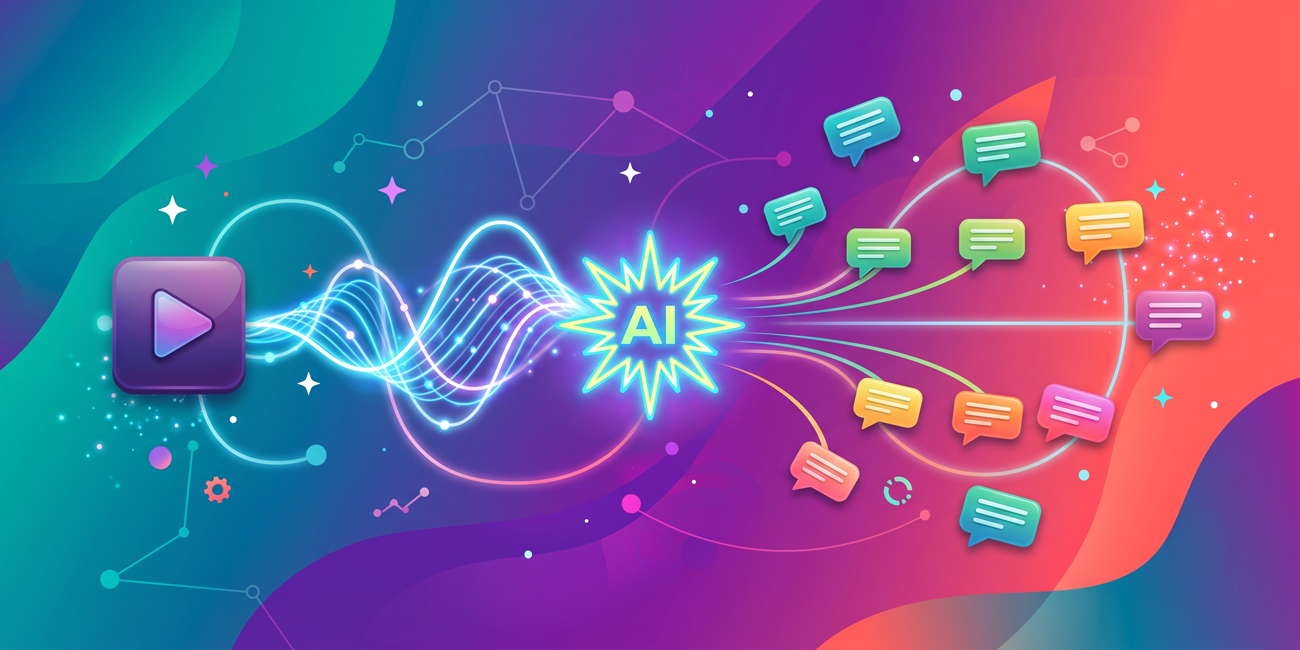
Modern AI video translation runs through five automated steps:
Step 1: Transcription
The AI listens to the original audio and converts speech to text using automatic speech recognition (ASR). State-of-the-art models achieve error rates below 2% for clear, well-recorded speech.
Step 2: Translation
The transcribed text is translated using large language models (LLMs). Unlike basic translation, these models account for sentence rhythm, length, and natural phrasing in the target language – because a translated sentence needs to fit the same timing as the original.
Step 3: Voice Cloning
This is the core of the technology. The AI analyzes the original speaker's vocal characteristics – timbre, pitch, speaking pace, breathing patterns – and generates a synthetic voice that reproduces these qualities in the target language. The result is not a generic AI voice. It is your speaker's voice, in another language.
Step 4: Lip Synchronization
The video image is processed so that the speaker's visible lip movements match the new audio track. This works best with front-facing camera footage – which most product videos, explainers, and sales presentations naturally are.
Step 5: Rendering
The final video is exported in the original quality. For a ten-minute video, this entire process takes approximately 15 minutes with current tools.
Who Benefits Most from AI Video Translation?
B2B Manufacturers and Exporters
Companies selling physical products or software internationally typically have multiple product videos, explainer videos, and sales presentations. These are expensive to produce and are often used in only one or two languages because translation costs seem prohibitive.
With AI video translation, every video pays for itself across all target markets simultaneously. A single production becomes a multi-market asset overnight.
Sales and Revenue Teams
Your best salesperson has a way of explaining the product that resonates. Their confidence, their timing, their specific word choices. Traditional translation gives that script to a stranger. Voice cloning keeps your salesperson's identity intact – in Italian, Korean, or Portuguese.
Training and E-Learning
Onboarding videos, compliance training, product certification courses: these are produced once and need to reach globally distributed teams. AI video translation turns a one-market training asset into a global one without re-recording anything.
Marketing Teams
Product launches, campaign videos, explainer content: synchronized market entry across regions is only possible if localized video assets are ready. AI video translation closes the gap between production speed and localization speed.
Internal Communications
CEO announcements, quarterly updates, change management videos: global organizations need every employee to receive the same message. Waiting weeks for agency translation defeats the purpose of timely communication.
AI Video Translation vs. Traditional Agency: An Honest Comparison
| Factor | Traditional Agency | AI Video Translation |
|---|---|---|
| Cost per 10-min video | $430–$650 | From $99 |
| Turnaround time | 2–3 weeks | ~15 minutes |
| Speaker's voice preserved | No (different voice actor) | Yes (voice cloning) |
| Lip synchronization | No, or very expensive | Yes |
| Languages simultaneously | Limited by budget | Up to 27 |
| Scalability | Linear cost per video | Near-flat cost |
| Revision cycles | Multiple rounds, slow | Immediate re-run |
When does a traditional agency still make sense?
For high-stakes advertising campaigns where native speaker emotional performance is critical. For highly technical content with proprietary terminology that requires certified translation. For videos where heavy regional dialect is central to the brand identity.
For the vast majority of B2B video content – product demos, explainers, training videos, sales presentations – AI video translation is qualitatively sufficient and economically superior.
The Leading AI Video Translation Tools in 2026
VideoLingua – Flat-rate pricing at €99 per video (equivalent pricing in other currencies), 27 languages, voice cloning and lip sync included, no subscription required. Designed for B2B product and sales videos. Results delivered by email in approximately 15 minutes. Free trial: first 20 seconds of any video at no cost.
HeyGen – The market leader with a broad feature set including avatar video generation, video translation, and presentation tools. Subscription-based starting at approximately $29/month. Excellent quality, but complex and expensive for low-volume users. US servers – GDPR compliance for EU businesses is unclear.
Rask AI – Specialized video translation with the widest language coverage (130+). Subscription model starting at $60/month. Good quality, no EU-specific data commitments.
ElevenLabs – Market-leading voice cloning technology, but not a complete video dubbing solution. Requires technical integration. No lip sync. Best for developers building custom workflows.
Synthesia – Creates new videos from text using AI avatars. Not a translation tool for existing videos. Different use case.
For a detailed comparison of costs and capabilities, see Video Translation Cost: What You Really Pay in 2026.
How to Translate a Video with VideoLingua: Step by Step
Step 1: Prepare your video URL Upload your video to a hosting service (Vimeo, Dropbox, or your own server) and copy the direct video URL. Note: YouTube links are not currently supported.
Step 2: Enter the URL Go to k4videolingua.com and paste your video URL into the input field. No account required for the free trial.
Step 3: Select languages Choose your video's original language and the target language. VideoLingua supports 27 languages including English, Spanish, French, Italian, Japanese, Korean, Chinese, Arabic, and more.
Step 4: Specify number of speakers Indicate how many different speakers appear in your video. This helps the AI clone each voice accurately.
Step 5: Receive the result Enter your email address and submit. Your translated video arrives in approximately 15 minutes. Download it and use it exactly as you would the original.
Frequently Asked Questions About AI Video Translation
How good is the quality of AI video translation? Quality depends primarily on the clarity of the original recording. Videos with a clear speaker, good microphone quality, and minimal background noise consistently produce professional-grade results. Heavy accents or poor recording conditions can reduce accuracy.
What video formats are supported? Most tools support MP4, MOV, and WebM. File size limits vary by tool – VideoLingua handles files up to 200 MB and videos up to 15 minutes long.
How much does it cost to translate a ten-minute video? With VideoLingua: €99, regardless of the target language. Traditional agencies charge $430–$650 for the same video, with a 2–3 week wait. Full cost comparison at Video Translation Cost 2026.
Does AI video translation really preserve the original speaker's voice? Yes. Voice cloning technology analyzes the speaker's vocal characteristics and reproduces them in the target language. The result sounds like the same person speaking a different language – not like a voice actor trying to sound similar.
How long does processing take? With VideoLingua, approximately 15 minutes for a ten-minute video.
Which video types work best? Speaker-centric videos work best: product presentations, explainer videos, tutorials, CEO messages, webinar recordings, and sales pitches. Fast-cut social media content with frequent speaker changes is less ideal.
Is AI video translation GDPR compliant? It depends on the tool and how the data is processed. If your video contains personal data (identifiable faces, voices), check where the tool processes and stores data. VideoLingua is built for the DACH market with GDPR considerations in mind.
What Makes AI Video Translation Different from Just Using Subtitles?
This question comes up constantly – so here's a direct answer.
Subtitles require your viewer to read while watching. For fast-paced content, technical explanations, or emotional moments, reading and processing video simultaneously reduces comprehension and engagement. Multiple studies show that dubbed content outperforms subtitled content in purchase intent metrics.
Beyond engagement, there's a trust signal. A video in your viewer's native language says: we made this for you. Subtitles say: we made this for someone else, but we're willing to translate for you.
For brand building and B2B trust, that distinction matters.
The Bottom Line: AI Video Translation Is No Longer Experimental
Three years ago, AI video dubbing was a curiosity. Today it's a production-grade tool that international businesses use to scale their video libraries without scaling their budgets.
If you're still sending English-only product videos into non-English markets – or waiting weeks for agency translation – you're leaving conversion potential on the table.
Your speaker already recorded the video. The technology can make them speak 27 languages. For €99 and 15 minutes.
Try VideoLingua free – first 20 seconds of your video at no cost →
Ready to translate your videos?
Reach a global audience with VideoLingua – fast, easy, and in your own voice.
Try for free →